Step 7 |
||||||
|
||||||
Next page |
Step 7
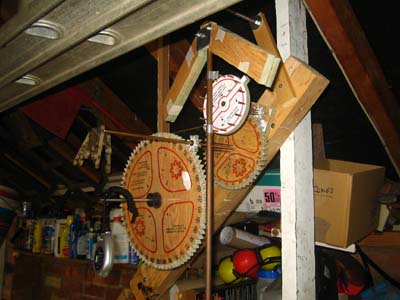
Time to see if the clock will work - I set up a very crude test rig with a temporary verge, pallets and foliot. Everything is adjustable.
Incredible, in just 20 minutes it was ticking away and just ran, even though the verge was not centred on the crown wheel and the supporting string was far too short.click here to see it in action!
I can now start to do lots of tests on it before making it into a real clock.
I will set up a camera to do time elapsed shots, so that I can let it run by itself! The elapsed timer is none too accurate, but hopefully the clock in the camera should be pretty good.
Testing notes...
This is a very crude set up, but I shall keep it the same for initial testing. The reason the Crown arbor is shorter than the rest, is that I'm using the cut-off from the very first experiments.
The foliot is completely lob-sided, although it is loose around the verge support, so that it can find its own balance point. In no way are the two arms the same size or weight!
The two foliot arms are 2.05cm thick x 19-16.5cm x 4cm and weighs 281gms (10oz). The hollow rod is 75.7cm long and weighs 175gms (6oz) with an external diameter of 9.37mm and internal of 7mm. This gives a moment of inertia of approximately 20000 (MxL^2/12) + 30 (1/2xM(R^2+r^2) for the rod.
Drum diameter is 21cms, from which a 2 litre plastic bottle hangs via a fishing line.
The verge jumps on the top pallet, but smoothly catches on the bottom one. I reckon they should be equal, so that the movement is smooth, rather than jerky.
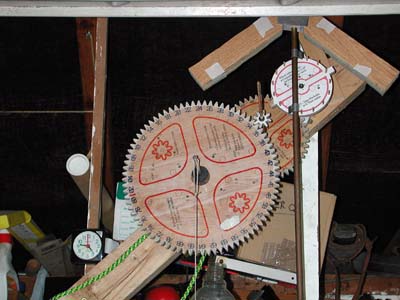
Here is an image from one of the elapsed time shots, with a line hanging down from the minute arbor to read the 'time' from and a clock in the background (in case the camera's clock is not accurate). At the end of each run a kitchen scale is place under the bottle to find the excess driving weight.
I will read the time just off the Minute wheel, rather than use all of the wheels - that can come later when the mechanism is more refined.
Also note that I've left the winding green rope around the windlass, but there should be some pegs to hold it proud - to further reduce friction.
Run 1: Just to see it running, although it seems to catch one of the pins now and then.
Foliot swing is around 68°. Stop weight 573gms in 1251 gms (2.75 lbs).
Bottom of foliot spread = 30.6cms with verge 2.5cm from crown face.Run 2: Camera interval at around 15 minutes. Stop weight 701gms, same total at 1251gms (=550gm driving).
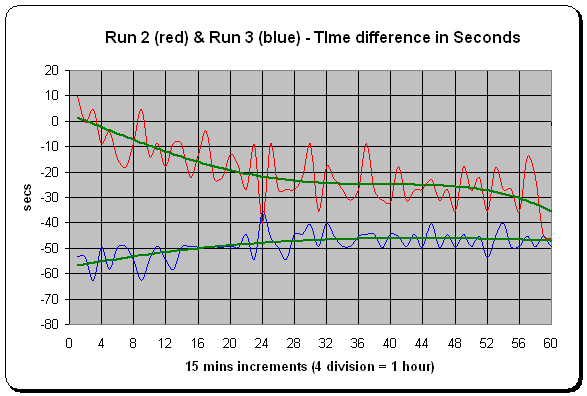
Below is the variation between the clock 'time' and real time over 15 hours. The clock averaged 0.97% slow compared to real time, loosing almost 20 minutes in all - just pot luck the timing was moderately close.Run 3: Reduced weight to 825gms (1 lb 13oz), which should be too low as Clayton reckons it needs about 2.5 - 3 lbs. Altered the foliot to 30cm spread and 2.2cm from the crown face. Kept the timing interval at 15 minutes. Stop weight 225gms (=600gm driving).
.
So for less weight and almost the same setup, it gives a slower tick loosing 48mins in 15 hours, but with less variation.
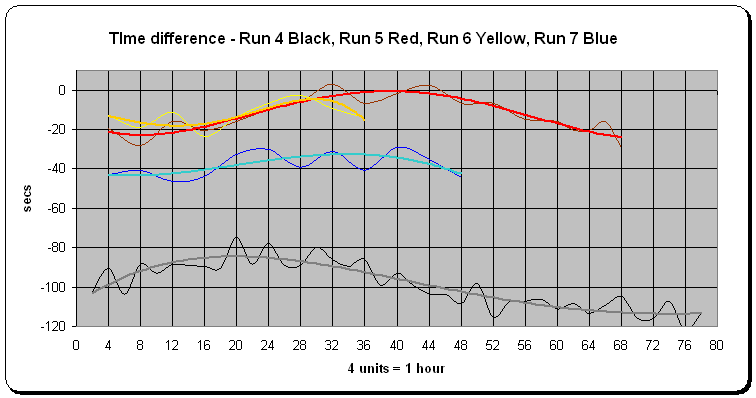
Run 4: Same conditions, but interval at 30 minutes, to check overall consistency. Stop weight 227gms. Different shaped curve (remember sec difference is 2x the 15min one), could this be an inaccurate drum radius? Lose 49 minutes in 15 hours - is this luck or will it really be less than 2 minutes variation in a day?
Run 5: Foliot distance reduced by 1cm at the bottom tips and photo interval of 1 hour, otherwise same conditions. I noticed that the wind (it was a bit gusty even at the back of the garage) blows the bottle about a wee bit (too big an area for the weight?). I wonder what that does to the foliot movement! I also notice that the bottle revolves (it is hung from one side) - will that make any difference? Stop weight 196gms (= 629gm driving). Looses 3 minutes in 15 hours - is at last my luck turning? - it was just a guess how much to move it. But it does show that it is quite sensitive and a bottom fine adjustment mechanism is definitely required.
Run 6: changed to a smaller bottle (same overall weight), else everything the same. But one of the the foliot leaves (each one is composed of a 12mm & 8.5mm piece of wood) slipped a tiny amount (thank heavens that the photos showed it) as the masking tape became undone after 7 hours! Looses 1 minute in 7 hours before it began to slip.
Run 7: Attempted to reset the foliot as it was before, else everything the same. The camera locked up after 12 hours! and lost 8 minutes in that time - so one needs an accurate way of setting the foliot spread.
Conclusion
I have been lucky in setting the clock to be not that far off the real time, but the important fact is that the maximum overall variation is less than 10 seconds per hour (4 minutes per day).
These runs are showing the same sort of curve, which is hopefully down to the drum varying in diameter along its length. I should not have been in such a rush to start with and done it properly in the first place!
So this crude set up, and tests, show that I have a mechanism that is well inside the 15 minutes-a-day target and running on less than 3/4s the suggested weight. Not bad for a rookie!
It will be interesting to see what happens when the inertia of the system is reduced, by cutting out the wheels, and whether this increases the variation as the clock becomes more sensitive to changes in weight and friction. I rather suspect that the weight/inertia of the minute wheel smoothes out these small variations - but, of course, the driving weight will also decrease, so maybe the changes to the mechanism will cancel each other out. If, however, it does get worse then there is a simple solution to add back more weight and thus return to this level of accuracy.
But I need to tackle the Drum and Verge (for real!) and do another round of tests before cutting out the wheels and thinking about the frame.
Next page