1 Basic Verge Testing |
||||||
|
||||||
Next page |
1 Basic Verge Testing
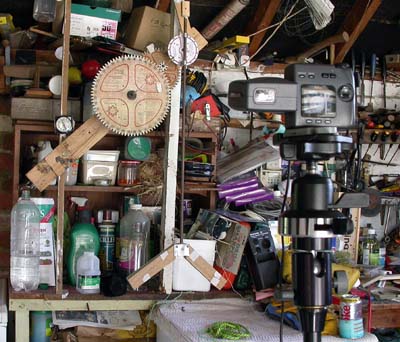
For these set of tests I've lowered the rig, to allow easier access to the top of the verge and then used an old metal pulley so that I get over a days running, if I am patient enough! The opposite image is of the set up with the weight at the bottom of the verge.
You can just spot the small bottle, top of the left upright, that is the driving weight. My camera is the fantastic Nikon 990, from 1999.
I've placed a thin pointer for the minute wheel, instead of the hanging string. But as each tooth movement is 45 seconds, the individual reading can be out by as much as 5 seconds (as I am attempting to estimate to the nearest 1/10th of a tooth).
Apologies for the tidy end of my garage!
Testing notes...
The length of the tests will not be consistent as they will fit in with whatever I'm doing at the time, but it should be more than 12 hours. I shall attempt to only change one thing between the tests.
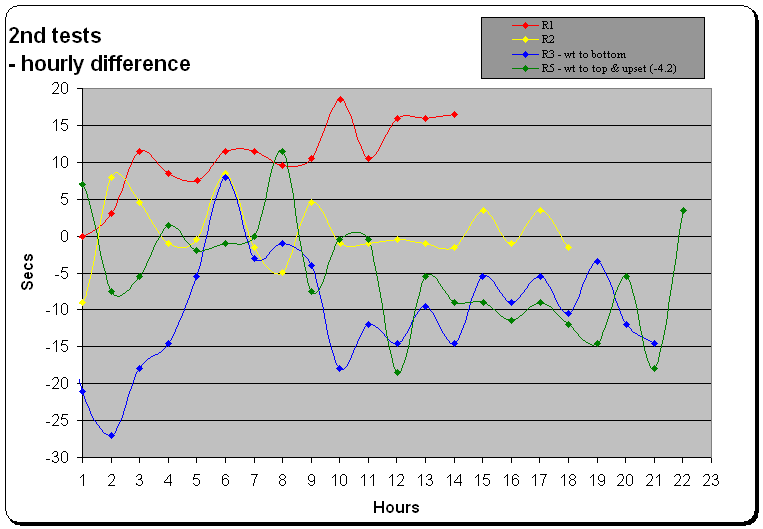
Run 1: As in the previous tests with a slightly different spread of the weights. Clock was 151 seconds fast in 14 hours.
Run 2: Spread the weights a little more to get closer to the time. Also removed the winding rope from around the drum. Result was a staggering 8 seconds fast in 18 hours of running! - must be just luck. I noticed that the pointer vibrates as the clock ticks and that the small amount of vibration is not consistent during the minute it takes the crown wheel to revolve. But its variations consistently repeat during the cycle. I guess this means that the crown pins are not exactly the same. Quick measurements show some of them to be almost 0.1mm out, both in height and spacing.
Run 3: Weights at the bottom of the verge, otherwise the same as run 2. The purpose is to see if we get less variation with all the weight at the bottom instead of the top. I thought I had not disturbed the weights, but the clock lost 3.5 minutes in 21 hours and it was much more erratic.
Run 4: Added paper 'wings' 10 x 10 cm to each weight, thereby increasing the frontal area by 100% per side, to see if wind resistance would be be a factor. The result was the clock stopped and the wind, not that there was much at the back of the garage, managed to swing the weights back and forth!!
Run 5: Placed the weights back at the top, to check I could get the same as run 2. But I must have altered the spread in run 3, because I now gained over 4 minutes an hour. I also rewound the clock after 20 hours to see what that did.
I then noticed that the swing was not the same during the one minute cycle. Not sure that this matters if each cycle is consistent.
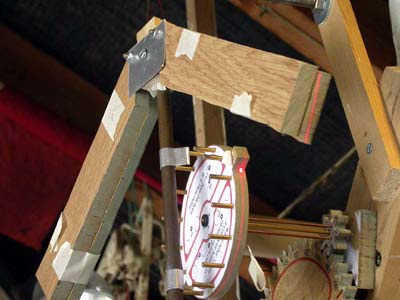
I placed a laser pointer to check exactly how much the swing varied, with the result of at least 8mm at the end.
But it was not exactly the same each minute, although there was the same sort of cycle, the positions were not always the same. Is this the difference in friction between the crown pinion and the 3rd wheel? I think we can rule out the driving drum diameter over a few minutes.
I need to repeat this when I make better pallets and a system of positioning the suspension line consistently, as each time I take the verge off, I am not certain that it goes back in exactly the same position.
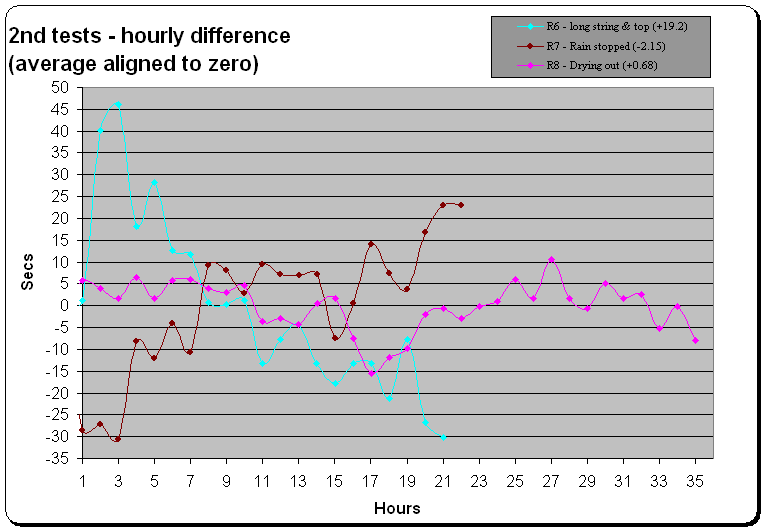
Run 6: Moved the suspension point up to 20cm, instead of the 6cm used in all previous tests. My what a difference. It is now much easier for the foliot to revolve, because the restraining force of the string is less. It now took over 1.5 minutes for the crown wheel to make a revolution. I moved the arms in as much as possible, but it is still running very slow and the amount of swing has increased by 6cm - that is a lot. The variation still seems to be around 8 mm maximum, but the top of the verge seems to moves more. I assume that the smaller the swing angle the better, as in pendulum clocks. Plus it started to rain during the run.
Run 7: In fact it rained all day and the clock stopped repeatedly when minute tooth 43 was engaged with the pinion and once each for tooth 32 & 38. So I add some more weight to get it going and let it run. I now need to pay attention to humidity and see how it performs as the weather improves.
Run 8: Weather getting drier, but then it rained again after 14 hours. Up until these last 3 tests, it has generally been fine. I put a humidity gauge to see what happens and there was a big change down and then slowly up around 16 to 20 hours - and that made the clock run slower by around 15 seconds/hour. The humidity then slowly kept changing for the rest of the run. The clock was rewound at 22 hour. Eventually more rain and it stopped at tooth 43 again.
Conclusion
Checking the camera's time against a normal clock, it can be out by a second, which makes the errors in the plots of up to 4 seconds an hourly interval, so I need to improve this in the next set of tests.
Changing anything makes a big difference, but humidity is the killer.
As the forces at the crown pins is small, I think air resistance makes a difference. It could not cope with an increase in surface area for the same driving weight (run 4).
Allowing great freedom for the verge, by putting the weight at the bottom, or moving the suspension point up, seems to allow more variation - but I'm not sure about this.
We have a number of factors which control the swing. The force/weight at the crown pins, equivalent length and weight of the bars and the any centering effect of the suspension string. Plus how much the verge can move away from the vertical and wind resistance.
Next page