|
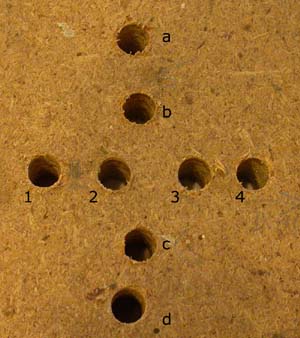
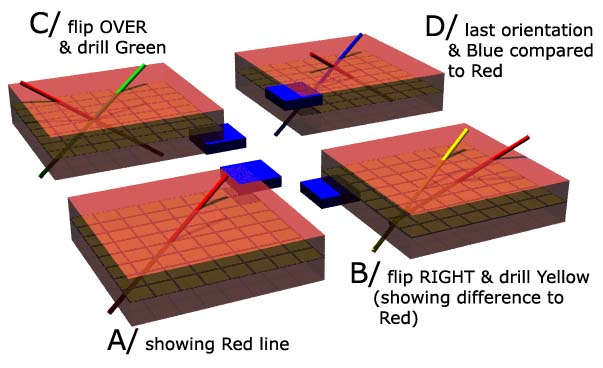
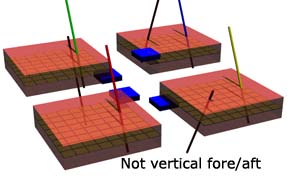
Holes 1, 4, b and c where drilled from one side and the others by
turning the wood over. To start with the drill stand has a
sideways movement of around 0.85mm of travel at the drill bit - so I
need to come up with a way of stopping that !
I would have been a good idea to use a sharp drill and I also
found if difficult to measure the distance between the holes with my
Digital Micrometer as the claws would not fit all the way through
the holes. Either bigger holes are needed or I need to insert
the drill bit (2 off) to be able to measure more consistently, as I
got up to 0.04mm variations between measurements.
The minimum distances were (top to reverse side)
1&4 - 31.45 and 31.72 - giving +0.27 difference
b&c - 19.05 and 19.16 - giving +0.11 difference
2&3 - 8.50 and 8.58 - giving +0.08 difference
a&d - 42.62 and 42.79 - giving +0.17 difference
quite a variation. So I need to be more precise.
|