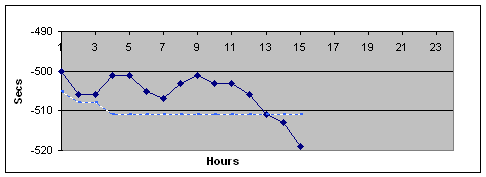
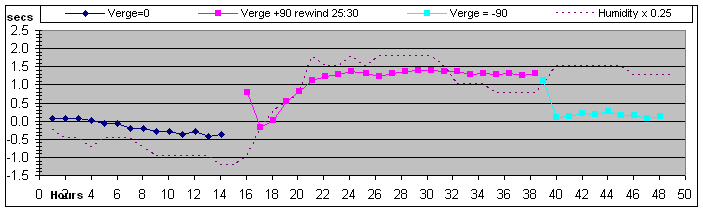
| I thought I had better check everything out, so I
did the free running tests and the weights were158gms and 444gms
(for all arbors) which is slightly less than before - so no problems
there. I then noticed that the old metal pulley was sometimes scraping
along the support one side, so I replaced it with plastic one on a
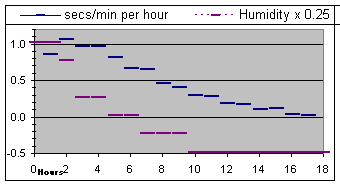
shaft. I put the driving weight at 874gms (10% off) as I
thought it was a bit too much. Run 5: Swing back at around 33° and
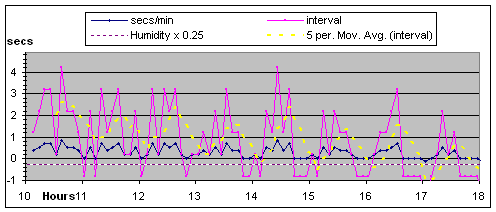
to see what was going on I set the timer interval to approximately 6
minutes (one revolution of the 3rd wheel) and so the plots are now
recording the gain/loss of seconds per minute (so that I can mix/match different time intervals)
as well as plot the interval difference (as in all previous runs).
Remember that I am luck to read the clock to within a second, but
within 2 is achievable.
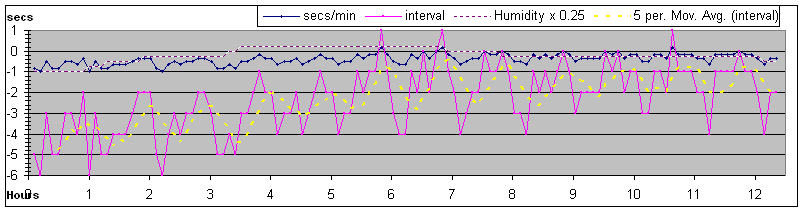
This is a most interesting plot and something I should have done
a long time ago. The yellow average line clearly shows how the
clock varies each complete revolution. I assume it is due to a lob sided
drum and/or some bad minute teeth. It also shows that
depending on the timing interval, I could have (at worse) an 'error'
reading of up to 5 seconds as the clock goes through its cycle.
I rewound the clock after 21.7 hours and positioned the drum at
180° relative to the minute wheel, to see if that would change the
up/down cycle.
It slowed down and stopped! But started again with a little
nudge.
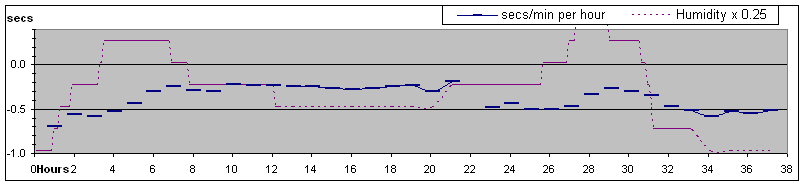
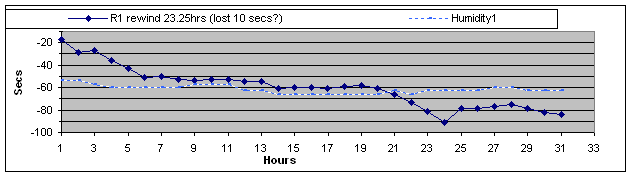
and here is the rewind period and how the clock behaved with a
different drum position. It is now slowing down (clock not
real time) around 38 minutes past the hour instead of 58 and is not
so consistent, but with smaller swings (although the humidity was
changing much more). So that should point to the drum being off centre,
which is not surprising the trouble I had when I started.
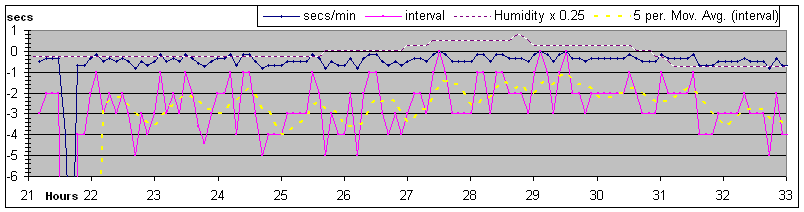 Instead of making a new drum
sub-assembly, I've tried sanding down the current one. The
problem was having over drilled out the centre, its position was
determined by the connecting pins and therefore it had to be sanded
with its ends on - not the easiest thing to do. Diameter is
now down to 18mm. Also the winding drum end plate was not
perfectly in line, which was causing more friction. I just
over-bored it as the other plates should hopefully hold it in
line. Basically I want to continue experimenting rather
than remaking the whole assembly! Run 6: I added a T bar at the
bottom of the verge to see if it was possible to adjust it more
accurately (in the future). Same 64gms at 9.6cm radius on the top bar (as
before) and nothing on the bottom one. Interesting that every
time I remove the verge, I do not get it back exactly the same -
must be the square edge to the wood and large hole, allowing a
slightly different position for the thread. Drum same position
(in line with tooth 66) as start of run 5.
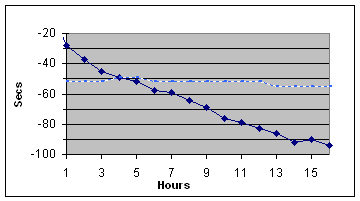
Well, either something is settling down or hopefully the humidity increase
(remember it is plotted inverted) is slowing it down. Looking
at the back end of this run in detail the up/down peaks cycle are
more pronounced and less obvious, but the troughs are still
happening around clock time 58 again. There is 1 second less
difference between the troughs and peaks compared to run 5, but that
does not seem a lot for (a) removing the wobble and (b) reducing the
diameter (1mm is equivalent to about 55gms in weight).
|
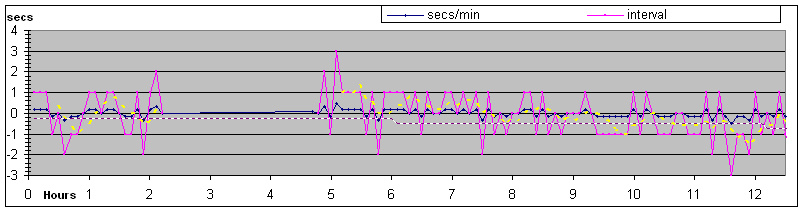
Run 7: Cut out the spokes on the minute
wheel - weight down from 364gms to 193gms. Everything else
the same and the drum positioned at tooth 66. The
timer gave up after a couple of hours, so there is a break in
the plot, but otherwise it is looking much better - so less
wheel weight seems to be the order of the day. Perhaps I
should remove the disc behind the crown wheel.
Listening to the clock, there seems to be less force when the
3rd wheel teeth 13/14 & 37/38 are in contact with the crown
pinion - I need to check this out sometime.
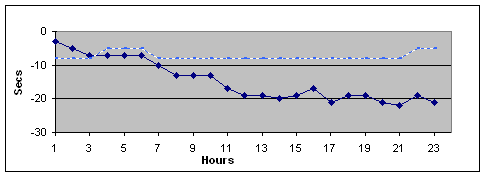
One can really see the effect of humidity on this run and
interesting enough the clock only lost 2.8 minutes in all - pot
luck!
The stop weight was 258 gms even with a smaller drum!
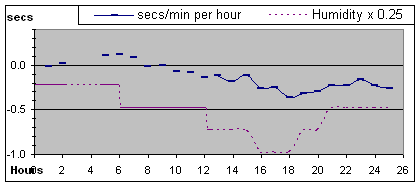 The detailed
plot shows less variation in the spread compared to before. |
 |
|