3 Oh dear - Starting again!

Well it seems that checking things out before doing it for real, does not always work.  The hardening idea completely failed and produced a sticky surface, so that it required twice the weight to drive the clock.  Why?  Well on asking the manufactures, it appears that there is little penetration if the surface is very smooth - so I have just ruined all the teeth.  I tried sanding etc., but could not get back to the original driving weight.

So I had to make some more wheels - for now I just did the minute wheel and it's pinion.  This time I used the thin MDF as I really could not stand the time it took with the thick stuff.  I also added to disc in front of the minute wheel to help it stay vertical.  Both the disc and the ratchet arbor holes were over-bored for most of their length, to reduce friction.  It weighed 379gms (compared to the thick 525gms) with the ratchet attached.

With all the trouble I had sticking the template onto the wood, I tried paper and covered it with sellotape to stop the edges fraying.  It helped quite a bit.  I then checked and sanded the teeth as before and got the driving weight down to 161gms to revolve the first two arbors, but up to 520gms for all of them.  So I'll potter on with the old 3rd wheel and pinion for the moment, even though the driving weight is now 1178 gms, a 121% increase compared to before.
 

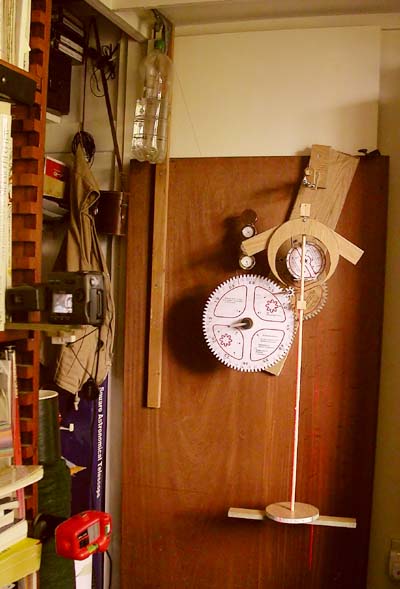
Because winter is coming, I've moved the clock inside, attaching it to a small plank screwed to the back of an old desktop, which is clamped to a cupboard door.

In the photo opposite you can see that I have the camera and laser pointer stuck out from the bookcase and the humidity gauge, thermometer and clock are hanging behind the minute wheel.  I've also mark the wheel in minutes and the crown wheel in seconds to help measuring the time.

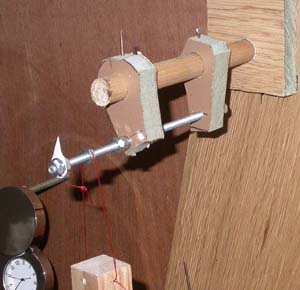
The verge suspension has changed to be more like the final idea.  Basically a threaded rod hung under the wooden dowel by scraps of off cuts. The suspension nut is now smaller at 6.95mm compared to the previous 12.6mm one, but the string length is the same.

Arbor distances before the change were 141.35mm, 90.83mm and 200mm for the verge.  It is interesting that now the 3rd arbor is not exactly horizontal  - perhaps the plank is not flat.  But this does not matter as their positions are all adjustable!
 

Run 1:
I now need to test to see if the doggy 3rd wheel and pinion will give me consistent results to continue my tests, or whether I have to make new ones.  The verge swing is 32°.

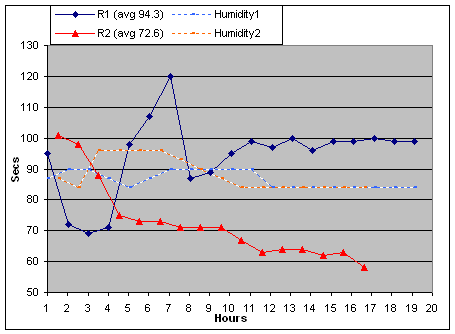
Why the sudden spike?  I've got a feeling it is the drum windings (as it was not nicely laid down, just wound by hand).

Test 2:
I reduced the verge suspension point from 23.5mm down to 7.9mm (Clayton's is around 10mm).  My what a difference - the swing averages the same, but the bottom of the verge wobbles much more and appears jerky with the angle varying from 29-50°, but not to a pattern I can see.  But the surprising thing is that the clock has slowed down enormously - 80 compared to 58.5 secs for a crown wheel revolution (everything else is the same).  Having a wide angle suspension helps the returning force on the return swing, making for a faster tick.

 
Tests 3:
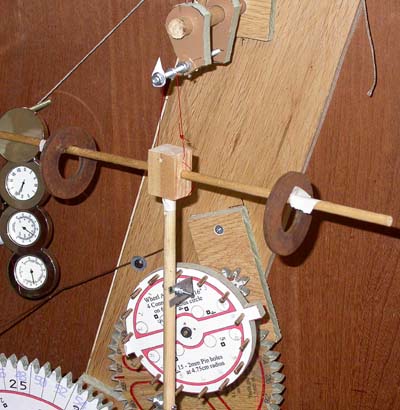
I then place a thin dowel on top of the verge, so I could add weights.  The weight was very small compared to the crescents at 311gms.  For stability I needed the bottom disc.

With the thin suspension and 64gms at 10cm radius, I got the same 80 seconds.  With no weights it was 40 seconds for the crown wheel to revolve.

With the thick suspension I got the following results with the 64gms weights, but the swing was variable from 40-46° with a hard knock on the pallets (indicating the driving weight was a bit much?).

cm radius

Crown secs

 12

76 

 10

64 

   9

60 

   8.5

58.5 

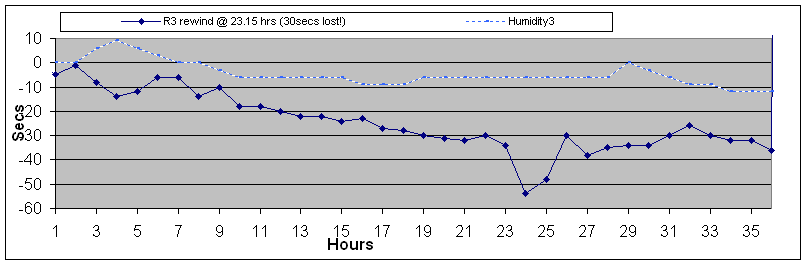
So Run 2 (red plot above) to compare this with Run 1.  It is slowing down, perhaps the weights are slowly moving outwards. The humidity plots are relative as before.
 

Run 3 is the top crescents, minus the inner bars, and the dowel with the weights set at 9.7 cms (held by rubber O-rings to make sure they do not move).  This should give more stability to the top of the verge.  It was a very interesting run.  The rewind lost me 30 seconds before it settled down again, but at around 29 hours in I noticed a quiet groaning noise, rather like a wooden ship on the sea, for about a quarter of the crown wheel revolution.  Just could not work it out.  Eventually found that one of the connecting rods was just sticking out the back of the pinion, which was why it was slowing down, until it eventually stopped.  This indicates that (a) they are not very tight and (b) the clock finds it own best position (if I haven't got the wheels exactly square to each other).  In this configuration the pallets were getting a fairly hard knock at the end of each swing.  So I measured the stop weigh (having corrected the connecting rod) 466gms - giving 712gms driving (use to be 600gms).

As I thought the driving weight was too much, I reduced it back to 971gms (like previous tests) and the stop weight was 289gms - giving a driving of 682gms. 

I also started to cut a new 3rd wheel and (crown) pinion.  I read somewhere that having two different materials sometimes helps to reduce friction.  So thought I would try the new pinion with the old hardened 3rd wheel.  Appears to be less friction.  I've reduced the swing to 25-29° and the pins are now hitting the pallets right at their ends.  By the way, I'm not worried about trying to make the clock keep time at this stage, I'm just looking for consistency.

Run 4: with the new crown pinion 'right out of the box'
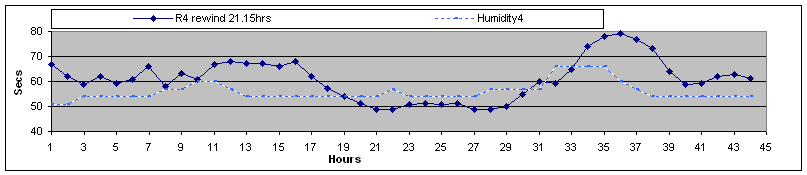
The stop weight was 330gms, giving a driving of 641gms - a bit better than run 3 with the old pinion.

All these plots have been taking the difference between the clock and real time for each photo interval.  These intervals are not equal as the timer can vary by as much as 7 seconds and (of course) I can only read the clock time to the nearest 2 seconds.  This means that the plots have a slight inbuilt error in them. So what if I plot the time shown by the clock compared to real time?
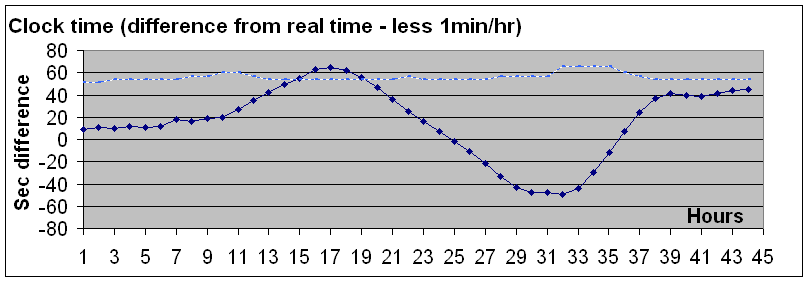
I would not have guessed this was the result - I'm continually surprised by these experiments.  This seems to indicate that the clock will be wrong by up to +/- a minute at any instant.  Is this luck?  It is much better than I hoped for and so I will stop watching and start cutting again - first the crown wheel.


  Next page

Content Menu