2 Verge configuration tests |
||||||
|
||||||
Next page |
2 Verge configuration tests
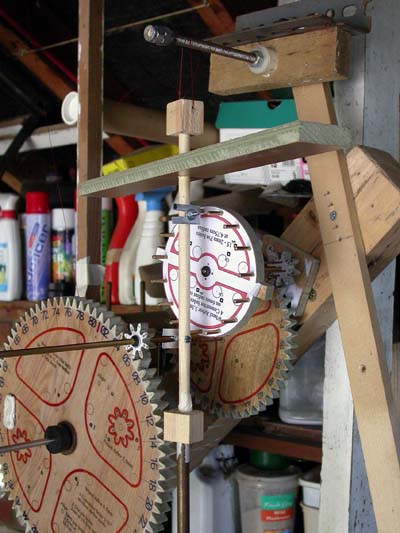
The purpose of these tests is to learn what factors change the timing of the clock. It is a 'play' set of experiments rather than actually accurately recording what is going on. So this (foul) looking setup uses a horizontal beam for the folio onto which I can easily add weights.
The horizontal position of the verge can be move sideways as well as the
back-and-forth distance from the crown wheel, via a bushed threaded bar.I can also replace the hanging block, especially the width where the wire is threaded.
The pallets are now my design (see description).
Also the bottom end of the verge can be replaced via another joining block.
The idea is to change bits and pieces and see if I can deduce anything!
The top bar weighed 155gms, well under the 'right' weight for accurate timings.
I used two sets of water weights, 960gms and 1386 (145% increase).
There was a bottom 131gms disc which I could add.
Firstly the horizontal bar was less stable than the V bars, I think because it did not balance so well and was not pivoted unlike the V bars.
Obviously (?) adding weights to the bar, slowed the clock.
Moving the verge in and out made a significant difference to both the swing angle and the timing. Turning the screw clockwise moved the verge away from the crown wheel and increased the speed of the clock (half a turn was about a second per minute) and similarly moving the verge inwards slowed the tick (again half a turn was around 1 second per minute). A turn is about 1mm.
Being able to move the verge sideways was useful to be able to set the beat of the pallets to be exactly the same.
I could not detect any significant change when moving the pallets in and out relative to the verge - but I have a feeling that I was not too exact in this experiment, as I would have to move the verge to get the pallets to engage again to get a good tick.
Without a doubt having vertical straight pallets was better than the hand bent ones, which we not exactly the same.
Adding a weight to the bottom of the verge decreased the amount of wobble. Interestingly the wobble virtually disappeared with a wooden dowel compare to the metal rod. I think this may be have been because the latter was not perfectly straight.
Adding centre weights to the top of the bar, helped the stability of the system. I almost believe that it be better to have more at the top, than at the bottom of the verge. But the total balance of the system had quite an impact on the amount of wobble. It therefore seems important that the foliot is allowed to pivot to find its own balance and thus the V bar was better than the horizontal one.
The extra water weight made around 3 seconds gain per minute.
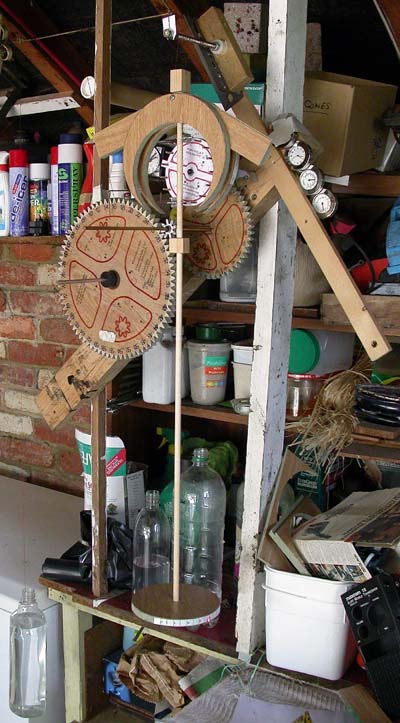
This is my third rig. I have changed the angle between the arbors to be more in line with my original design ideas, rather than a straight line as in previous rigs.
Starting from the top. I have retained the suspension thread mechanism. Although I am not happy with the way the fishing line sticks in the threads of the nuts, making me adjust them after moving the verge back/forwards. Also hanging the line in the thread gives it a slight twist which results in an asymmetric swing.
Now there is a sandwich of foliot pieces. Two crescents with a beam sandwiched between them, which is only attached to the rear one (via hidden bolts). The whole set pivots around a bolt through the verge.
The advantage of this system is that I can accurately record the spread of the foliot beams, using marks on the rear crescent.
As before the pallet pins can be separate from the bottom of the verge, currently a wooden dowel is attached.
The disc at the bottom has a scale on it, so that the swing angle can be easily read with the laser pointer. It is normally around 33°, but I can get it as low as 25°.
The temperature and humidity can now be recorded (gauges on the right).
I have measured and corrected the length of the crown pins, from the crown face, as I noticed the beat was a bit irregular. I had a maximum of 23.7mm and a minimum of 23.1mm - I should have checked when I made it, I just pressed them in a vice and assumed they would stick out the same amount!
First, the big surprise was that adding 2 x 63gm weights, 4 cm out from the verge centre, to the bottom disc made the clock go faster by about 2 seconds per minute! WHY? I just did not believe this and tried it twice on two different settings.
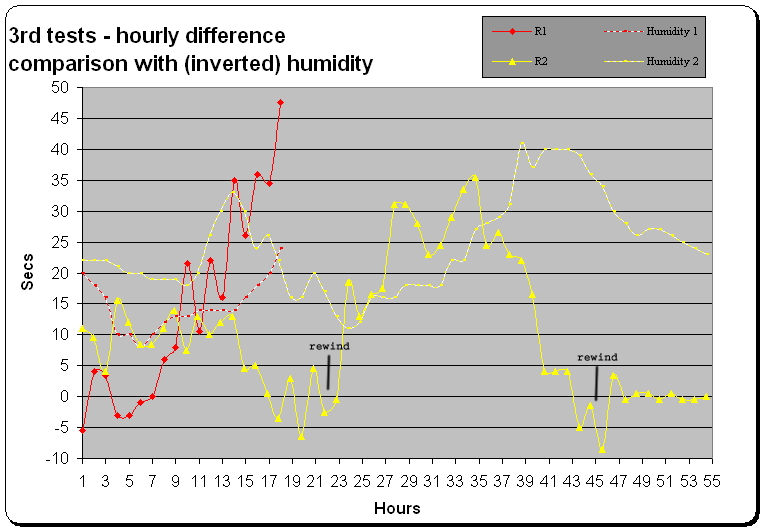
Just to see how things were ticking, I did a wee run (run 1).
I then had a frustrating day. I decided to cut a grove in a nut and rest the string on that, instead of in the threads. Wow, the clock gained 15 seconds/minute, with nothing else changing! Eventually I almost return to the status quo by cutting nearly all the way through the nut, so that the string had almost the same diameter at its top as before. The swing was now much more symmetrical. I was amazed that such a small difference () would make such a large change. It appears that everything is interlinked in controlling the beat.
I then understood the adding weights increasing the speed mystery (see above). At last I think I am seeing that there are two aspects I have been muddling. Weight and centre of gravity - and I'm sure the moment of inertia also plays a part with the force being given to the crown pins.
I added the old top bar (155gms) under the disc and tried another run (run 2), so the verge & foliot now weighs more.
It was only after I had started the second run, that I plotted the first one - oh dear the humidity changed the beat so much, that part of the 15 second gain was due to it. But I thought it would be interesting to do a long run as the weather was very changeable.
I have inverted the humidity so that high is down. The clock was rewound twice during the second run. There seems little point in trying to do accurate timings with so much variation.
Conclusion
What variations compared to my initial runs - I was very lucky that I started the tests when the weather was kind to me, otherwise I would never have realised that the clock can be quite accurate under constant conditions.
I must confess that one of my objectives was to try to get the clock as accurate as possible. I have been putting off hardening the teeth, until I had a stable system to test against. But now that we are into a long spell of variable weather, with some recent violent downpours and autumn is coming, I guess I shall have to give up and paint the teeth before I cut the wheels out.
Next page