Step 4 |
|
|
|
Next page |
Step 4
I like a challenge, but this is ridiculous!ABSOLUTE DISASTER - the film and paper is not sticking to the wood on every tooth. Some are okay, with others the film lifts from the paper and just to add a spot of variation, in a few cases the paper & film together are lifting from the wood. I had thought I might manage to still sand okay, but this is folly, especially when trying to separate the film and paper, the printed line comes off!
I had cut 30 of the Minute teeth and tried coarse sanding a few, but it was hopeless. Because some of the teeth were fine, I guess it may be not enough glue, but there still seems quite a bit left in the can.
I then tried a few teeth on the Movement wheel (from the 8.5mm stock), but with the same results. Perhaps it is daft to use MDF flooring - tough and slippery - anyway I'm not ready to be beaten just yet...
Time for a bit of a bit of a re-think
Guess I'll first try stripping the templates off and then repositioning a new transparent template and see if that will work.
I did this to the Movement wheel. The 6" wheel weighed 154gm roughly cut.
Well that went reasonably well, although the film still lifted off a few teeth. With teeth all cut and sanded down, it weighed 133gms. I must say it is a pleasure to sand, rather than cut teeth, and the sand paper strips last longer than blades!
At last I feel I'm back on course, but I got tempted to see how well a wheel and pinion would work with my tooth profile.
So I decided to cut the Pinion to the Movement/3rd wheel, just using a paper template this time. This wee 1" wheel only weighs 2gms on completion.
Much harder to see the lines, but it went well and the two wheels meshed quite well, with just a bit of extra sanding to tooth 35-37 when doing spin tests.
Back on course
Back to the Minute wheel - cut the rest of the teeth out and roughly sanded them, where the lines were visible. This brought the weight down to 526gm (from 567gm).
[Why am I recoding weights? Well I read on the instructions to the MLT-12 clock that it's Great Wheel was thick and heavy to give additional power to turn the pinion. I do not understand this, as I thought the less weight of a wheel the better. I have no intention of re-doing the Minute wheel, but I shall see how the clock behaves as I cut out the middle of each wheel (starting with the Crown), once I get the whole thing working.]
Crown wheel
I needed more adhesive and so while I'm waiting for some more Spray Mount (much cheaper on Ebay than in the shops), I cut out the Crown Wheel. The 4" wheel weighted 62gms. It did not seem sensible to sand this wheel with the sanding disc, because of the two bits sticking out. I found using the Scroll Saw to sand was dead easy and I foresee no problem in using this method, when I cut out the insides of the wheels [somebody had mentioned on the web that they were forced to sand the inside of the cut-outs by hand, which I did not fancy].
I added the 3mm pins to the Crown wheel, rather than the design's 2mm ones, because I had been having so much trouble with drilling vertical holes with small drill bits. This brought the weight up to 82gms.
Minute Wheel
I stripped the template and place a transparent one on it and this helped with the final sanding of the teeth. I left the teeth after the 60grit sand to see if I could detect a decrease in friction with finer sandings later.
And just the Pinion to do - lovely just doing 8 teeth and they seem to spin together quite happily.
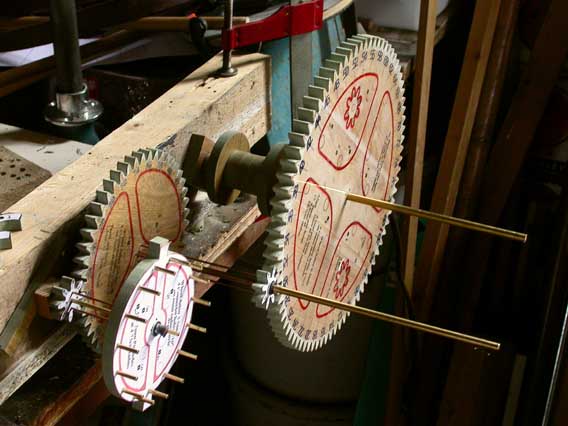
So here are the arbor components in my 'test' rig. I've left the 2 of the abors long, so that I can test different ways of polishing them.
It is so so tempting to make the verge and see if I can get the clock to tick. But if I did that I would not learn anything, just be a copycat, and I see little point in doing that.
So the next step is friction testing...
Next page