A Mad idea
In a pendulum clock, the length of the pendulum varies with temperature and changes the timing of the swing. So people use different metals to compensate. For a wooden verge & foliot clock I need the same sort of idea but based on humidity. Lets see if I can added such a compensator mechanism.
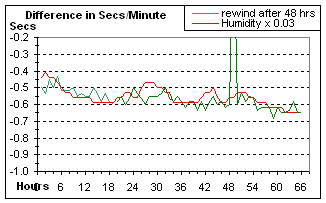
On setting up this experiment, I placed the weights at 9.2cm radius which gave a good time loss - 0.5s/m. However something has change the dynamics, because (according to the pervious experiments) this distance should give me a 1.7s/m gain. The swing was now at around 42°, much larger than the usual 30-35°. Rewinding the clock really upset the system and the jerky motion jumped the pallets off the pins - this is not acceptable!
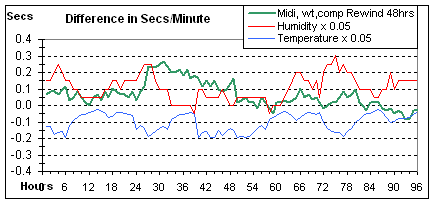
I had to offset the humidity values to fit the graph. The humidity started at 58% (as before) and finished at 65%.
However this idea seems to help, as I had to reduce the percentage of the humidity from 5% to 3% to get the two plots to align. The weather was not so variable and thus not so convincing, but I believe this is correct. I really need more variable weather to confirm this.
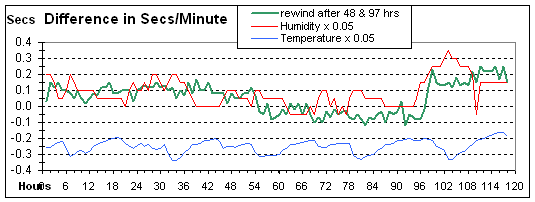
I firmed up the compensator, with metal rods, and the clock now rewound as before with no jerks and the maintainer keeping the clock running. To get a reasonable time, I had to place the weights much closer at 8.5cm radius (still using the 2 washer weights) and the verge dial at 0°. The swing was rather large at about 50°
The humidity started at 62%, minimum of 59% and ended at 63%.
The weather was against me - not enough change. Also as I'm reading to the nearest 4 seconds, it is difficult to say anything conclusive, except that there is no obvious relationship between the time, humidity or temperature!
Look at the humidity peak (trough on the graph) at 110 hours, it just shows that taking spot readings can be misleading!
I really do not know what is going on with that run. I think I have introduced too much variation, but I really need better variable weather to check it out. Just to check I have not upset anything in the clock, I shall repeat a previous run before this mad idea. So now the weather keeps changing - why didn't it do it before! Anyway this shows that the clock is as before.
Time to start firming up the final verge design. I basically want most of the wood weight to be fixed and not adjustable, leaving me small weights to fine tune the system.
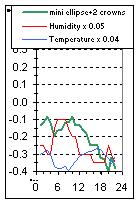
I've gone for an ellipse base to help form the basic weight of the system (along with the crescents). Mk1 is small, with diameters of 14 & 23.5cm and weighs 293gms. It needs a couple of (28gm) English crowns at 6.15cm to give the following plot.
Humidity rules!
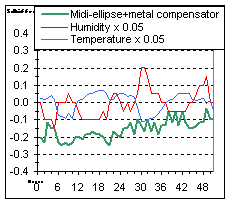
Mk 2 is a little bigger with diameters of 14 & 26cms and weighs around 330gms. It only needs a (12gm) small washer at 8cm to get a reasonable tick. Placing these in the compensator gives this plot. [I'm not worried about the up & down sawing of the plot because the verge is mostly stationary (as far as the camera is concerned) at the end of each swing and then quickly turns for the next swing.]
Humidity doesn't rule - but what does?
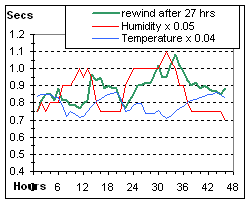
I replaced the metal rods and washers of the compensator by lighter (4gm) wood dowels (without additional weights) - this should remove the temperature element if there is one.I therefore needed single crowns at 5.5cms to get a reasonable timing. The verge dial was rotated +90° for final tuning. Quite a large swing at 42°.
Humidity started at 59%, with a maximum of 63%. The rewind was not that good with a few pins jumping off the verge giving a gain of 10 seconds.
This is probably the best I can hope for and the humidity effect is much less.
I think the big jump at 24 hours was the line overlaying on the big pulley, although it is very difficult to see as the line is so thin and the groove so deep - I need to move it out a wee bit to be more centrally aligned with the drum.
This is clearly not giving me an obvious solution, so I shall construct the final verge and try it on that!
Next page