Clock Face

 
How can we have a normal clock face, but without hiding any of the mechanism?  The simplest idea I have come up with is to use a Planetary gear to achieve the 12:1 reduction.
 

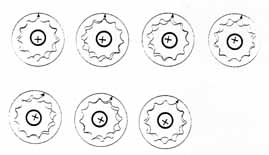
The simplest form of planetary gearing only needs two gears - a ring gear of 12 teeth rolling around a spur gear with 11 teeth.

The centre of the spur is indicated by the circle and the cross marks the centre of the ring gear. The ring gear can turn on its own axis, but the spur gear cannot. As it rolls once around, the ring gear advances by one tooth space, or a 1/12th of a revolution. The rolling motion is produced by a crank driven from the centre.

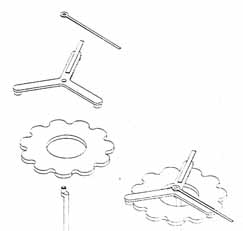
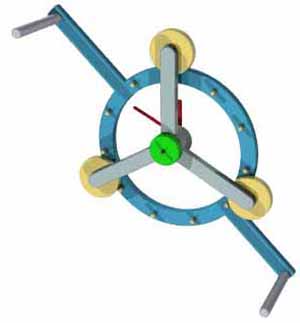
Believe it or not, the whole mechanism can be simplified by having a fixed spur gear of an 11 lobed cam and the ring gear is shrunk to a spider with just 3 pins - as shown opposite.

The theory is that as there are so many teeth in mesh with this layout of gears, that having a few (!) missing doesn't seem to matter.

 
Here is the extra mechanism on it's own, with fixing pins to the back wooden frame and the axle of the minute wheel pinion.


Note that the back of the clock face holds the 11 fixed spur wheels - actually just fixed pins (I hope).


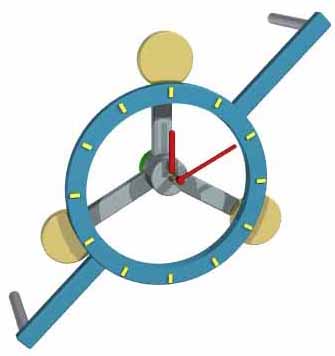
The 3 ring gears will revolve around them. The green hub is the offset cam to drive the ring spider.

The size of the spur and ring gears can be varied as long as their combined radius is the same - for the same radius circles holding them and the offset distance.

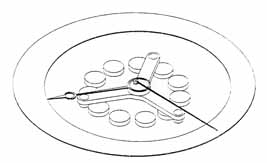
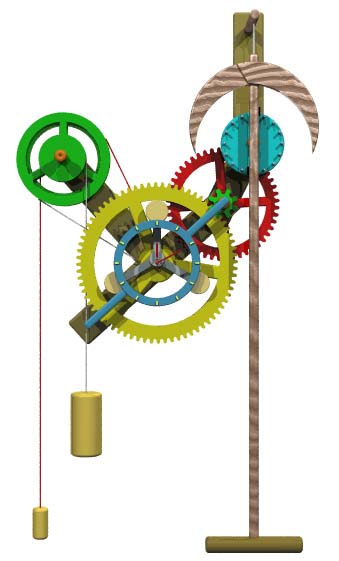
So the clock would look something like this...

This has been a very interesting exercise and I have learn quite a bit about wooden clocks.

I now need the actual plans to see how wrong my assumptions have been from the pictures on the web.


Next page

Content Menu


.